




Brèves
APPROCHES CRITIQUES DE LA RACE 2024
Le séminaire « Approches Critiques de la Race – ACR » est co-organisé par la Faculté de Philosophie et Sciences Sociales, La GERME – Université libre de Bruxelles, le Laboratoire d’Anthropologie des Mondes Contemporains -lamc, le BIRMM, la VUB et l’Observatoire du sida et des sexualités de la Faculté de Psychologie, Sciences de l’Education et de la Logopédie.
The Critical Approaches to Race (CAR) lecture series has the ambition to offer an academic space for young researchers in which to present their work, whether in progress or completed, and enrich their reflections. The CAR seminar invites to an approach combining decolonial and postcolonial theories and Critical Race Theory through the questioning of phenomena linked to race and racism in different contexts.
This is the first university seminar organized in Belgium on Critical Race Theories, a mainly English-speaking multidisciplinary field of study aimed at analyzing not only the forms of racialization and racism in human societies (Western and non-Western), but also the forms of subjectification that racialized people resort to in the face of racialization.
UPCOMING EVENTS:
26 SEP. 24 | 19H
Pianofabriek, Rue du Fort 35, Saint-Gilles
“Launch of firstwaves.be. An open web platform that unveils the struggles for dignity of the Maghrebi and Black diasporas in Belgium (1918–2000)”
10 OCT. 24 | 10H-12H
ULB, bâtiment S, 12e étage, salle Rokkan
Lionel ZEVOUNOU – “L’égalité dans ses rapports à la race. Des discriminations subies par les travailleurs marocains de la SNCF (1970–2018)”
Cette enquête propose une plongée au cœur d’une discrimination instituée à l’échelle nationale visant des milliers de travailleurs marocains de la SNCF : les « Chibanis ». Accompagnés de leurs descendants, plus de 800 travailleurs ont introduit un recours devant le Conseil des prud’hommes de Paris puis devant la Cour d’appel du même ressort qui, le 31 janvier 2018, reconnaît définitivement l’existence d’une discrimination en raison de la nationalité. Ce recours demandait réparation pour les discriminations subies dès les années 1970 par la venue de travailleurs marocains dans le secteur des chemins de fer français. Alors que ces travailleurs relevaient d’une convention bilatérale signée entre la France et le Maroc en 1963, garantissant les mêmes droits entre travailleurs français et marocains, la Société Nationale des Chemins de Fer français (SNCF) et l’État vont s’attacher à les intégrer au sein d’un régime (celui d’auxiliaire) générant une discrimination raciale à l’encontre de cette catégorie de travailleurs marocains. En rabattant le critère de la nationalité (nécessaire à l’accession au statut de cheminot) sur la jouissance des droits sociaux du travailleur, ce dispositif discriminatoire mis en place par la SNCF avec les moyens actifs de l’État (français et marocain) va perdurer, alors même que la France ne va cesser de ratifier plusieurs instruments internationaux interdisant les discriminations fondées sur la nationalité ou la race (OIT, CESDH, directive « race », etc.)
About the Speakers:
Lionel Zevounou est maître de conférences en droit public à l’université Paris Nanterre, chercheur au Centre de théorie et analyse du droit (CTAD, UMR 7074).
14 NOV. 24 | 10H-12H
VUB, BsoG, Pleinlaan 5, -1 floor, room Lisbon/Rome
Solène BRUN – “Diffuser et vulgariser les approches critiques de la race en sociologie : retour sur deux expériences de co-écriture”
A partir de l’ouvrage récemment paru aux éditions Textuel et co-écrit avec Claire Cosquer (chercheuse FNS senior, Université de Lausanne), Solène Brun reviendra sur les ressorts de la domination blanche et l’intérêt de justement penser les choses en termes de domination (plutôt, par exemple, qu’en termes de privilèges). La séance sera également l’occasion de revenir sur les manières d’enquêter sur la blanchité, position raciale indicible parmi toutes.
About the Speakers:
Solène Brun est docteure en sociologie et chargée de recherche au CNRS depuis 2023. Elle travaille sur les questions raciales et les processus de racialisation en France. Elle a co-écrit, avec Claire Cosquer, Sociologie de la race (Armand Colin) en 2022, puis La domination blanche (Textuel) en 2024. Elle a aussi publié Derrière le mythe métis (La Découverte) en 2024.
12 DEC. 24 | 10H-12H
ULB, bâtiment S, 12e étage, salle Doucy
Alana HELBERG-PROCTOR – “Doing diversity in health(care), doing race?”
Inclusion and diversity are currently ‘hot’ topics in health research, care, and policy in Europe. In recent years there have been calls at national and EU levels for healthcare professionals, health researchers, and policymakers in Europe to attend to diversity and inclusion. Bias and inequality in health and healthcare are produced by the exclusion of diversity, but bias is also produced by the inclusion of racist and stereotypical thinking in medicine and healthcare. While inclusion and diversity are indeed crucial topics in healthcare and medical education, operationalizing diversity around ethnicity and population differences is a difficult task with many pitfalls and complications. During this lecture I discuss how scientific knowledge and facts about ethnicity and race related to health are utilized and produced in the Netherlands, and beyond, and how these modes of scientific knowledge production are deeply and problematically intertwined with society and politics.
About the Speakers:
Dr. Alana Helberg-Proctor is an Assistant Professor in the Health, Care and the Body programme group at the UvA Department of Anthropology. In her work, she focuses on diversity and inequality in healthcare and medical science. She investigates how ‘race’ and ‘ethnicity’ appear in biomedical research, health policy, and healthcare in the Netherlands and Europe. More specifically, she explores how scientific and technological practices in care and medicine are intertwined with society, politics, cultural values, and context. In 2021 she was awarded the Marie Curie Sklodowska research grant (2021-2022).
23 JAN. 24 | 10H-12H
VUB, BsoG, Pleinlaan 5, -1 floor, room Lisbon/Rome
Remi Joseph SALISBURY – “Universities, Black students, and the (re)production of whiteness through securitisation”
In this talk, I examine the presence of security services and police on university campuses, focusing on their disproportionate impact on racially minoritised students generally, and Black students specifically. Drawing on high-profile case studies and original empirical research, I explore how the construction of the university as a ‘white space’ positions Black students as ‘space invaders’ or ‘bodies out of place,’ a reality that is (re)produced through campus securitisation. Using the concept of whitening-securitization, I highlight the overlooked role of security services in perpetuating institutional racism and maintaining whiteness. Engaging with securitisation, I argue, provides a much fuller understanding of institutional racism in Higher Education.
Remi Joseph-Salisbury is a Reader in Sociology at the University of Manchester, specializing in racisms and antiracisms, particularly in education and policing. He is also visiting scholar at the Center for Place, Culture and Politics at the City University of New York. He recently led the first study to examine the impact of security services on students in British universities, resulting in the publication of Whose Campus, Whose Security?
About the Speakers:
Remi is currently leading a Leverhulme-funded project exploring the impact of police presence in schools. He co-authored Anti-Racist Scholar-Activism (2021, Manchester University Press), which won the 2023 Society of Professors of Education Outstanding Book Award, and co-edited The Fire Now: Anti-Racism in Times of Explicit Racial Violence (2018, Zed Books). His first book, Black Mixed-Race Men (2018, Emerald Publishing), received the Philip Abrams Prize for best first book in Sociology.
His recent work covers topics such as police in schools, campus securitization, pandemic policing, police abolition, and racism in British education. Remi is a steering group member of the Northern Police Monitoring Project, the No Police in Schools campaign, and a member of the Centre on the Dynamics of Ethnicity (CoDE).
13 FEB. 25 | 10H-12H
ULB, bâtiment S, 15e étage, salle Janne — Séminaire ABBA
Khaoula MARTI – “Vulnérabilités, racismes et subjectivités politiques en Tunisie : le cas ethnographique des migrant.e.s de l’Afrique de l’Ouest” & Yasmine AKRIMI – “Race, Féminité et État-Nation en Tunisie : Intersections et Subversions”
Khaoula MATRI – “Vulnérabilités, racismes et subjectivités politiques en Tunisie : le cas ethnographique des migrant.e.s de l’Afrique de l’Ouest”
L’externalisation des frontières européennes est souvent conçue à travers les accords de réadmission ou d’expulsion des migrant.es en situation irrégulière, renvoyant ainsi aux politiques de gestion et de contrôle des populations en mobilité. Au cours de la conférence, nous nous pencherons sur le paradoxe inhérent à cette approche de gestion. Nous explorerons notamment les effets et impacts de ces politiques sur la vie et les corps des migrant.es, en nous appuyant sur une enquête ethnographique réalisée en Tunisie entre 2023 et 2024. L’objectif sera d’analyser les enjeux liés à l’im-mobilité des populations subsahariennes en Afrique du Nord, ainsi que l’impact des régimes frontaliers sur les subjectivités. Nous mettrons également en lumière le rôle de l’idéologie de la « crise migratoire » dans le renforcement des inégalités et le processus de racialisation des personnes en mouvement.
About the Speakers:
Docteure en sociologie de l’Université de Tunis et de l’Université de Paris V Descartes, Maître-assistante au Centre d’Anthropologie, Faculté des Lettres et des Sciences Humaines de Sousse, (FLSHS) et chercheure associée à l’Institut de recherche sur le Maghreb Contemporain (IRMC). Elle co-pilote des ateliers de méthodologie en sciences sociales, et le séminaire « chercheures et féministes : engagement(s) et production scientifique, responsable scientifique du programme de recherche : Vulnérabilités, racismes et subjectivités politiques en Tunisie : le cas ethnographique des migrant·e·s de l’Afrique de l’Ouest. Autrice de travaux concernant la violence contre les femmes, la condition féminine en Tunisie, la question du corps, du voile, de la sexualité et des normes sociales.
Yasmine AKRIMI – Race, Féminité et État-Nation en Tunisie : Intersections et Subversions
Mes recherches doctorales portent sur les dimensions culturelles de la race dans la Tunisie postcoloniale, en dépassant les analyses traditionnelles centrées sur le racisme structurel (telles que les inégalités juridiques, la ségrégation, ou l’accès aux services publics). En m’appuyant sur le concept de « chromatisme » développé par Ergin (2008 ; 2016), qui désigne une fascination pour la couleur de peau et les caractéristiques physionomiques, j’analyse la manière dont les métaphores raciales participent à la construction de la modernité tunisienne. Cela passe notamment par une compréhension duale de la blanchité, perçue à la fois comme un ensemble de propriétés physiques et comme un cadre de pensée hérité du colonialisme (Khiari, 2016). Plutôt que de me concentrer sur des actes de racisme manifeste, je m’intéresse aux idées racialisées qui façonnent subtilement la vie quotidienne en Tunisie, influençant ainsi les normes sociales et esthétiques. Cette imagerie chromatique, ancrée dans l’histoire complexe de la modernisation tunisienne, persiste dans les aspects les plus ordinaires de la vie quotidienne, en contribuant aux distinctions sociales et culturelles.
À travers une approche mêlant travail ethnographique et analyse digitale, je mets en lumière la manière dont les femmes noires tunisiennes sont particulièrement marginalisées dans ce cadre. Mon argument central est que, pour comprendre la race et le racisme en Tunisie, il ne suffit pas de se focaliser sur l’héritage de l’esclavage transsaharien (qui constitue l’axe principal des travaux existants), mais qu’il est impératif d’intégrer la région dans un cadre global de suprématie blanche, dont le néolibéralisme constitue aujourd’hui le système économique hégémonique.
About the Speakers:
Yasmine Akrimi est doctorante en sciences politiques à l’Université de Gand et militante décoloniale. Elle est également analyste de recherche pour le Brussels International Center, et écrit régulièrement pour nombre de médias et centres de recherche en Europe et en Afrique du Nord. Elle a publié « Racisme, blanchité et État-nation : la construction de l’altérité des Noirs tunisiens » chez Confluences Méditerranée en 2023.
20 MAR. 25 | 10H-12H
City Venue TBC
Folashade AJAYI – “Bending the Master’s Tools? Researching Blackness and (Anti)Racism in Academia”
Reflecting on personal experiences and thinking with different Black studies scholars, this seminar engages with the potentialities and limits of academia for transformative knowledge and realities. Historically, academia has played a pivotal role in the development of race-thinking, racialised hierarchies, colonialism, genocide, and enslavement. In short, academic knowledge production has been key for mapping and mastering the world. At the same time, decolonial (racialised) scholars continue to provide empowering knowledge and spaces despite the coloniality of Western academia. This seminar opens a space for sharing, discussing, and reflecting on these tensions by asking: What does it mean for our research if academia and its dominant epistemologies are master’s tools?
Folashade Ajayi is a PhD Researcher at the Brussels School of Governance, where she is affiliated with the ‘Migration, Diversity and Justice Research Centre.’ She is also a member of the ‘Brussels Interdisciplinary Research Centre for Migration and Minorities’ (BIRMM) and the RHEA Centre of Expertise on Gender, Diversity and Intersectionality. Her research focuses on Black activism and Black feminist imagination, intersectionality, and anti-racist policies.
About the Speakers:
Ajayi earned an MA (summa cum laude) and a BA in Social Sciences from Humboldt University Berlin and studied Political Sciences at Université Libre de Bruxelles. She has been actively involved in Black grassroots organizations in Berlin and contributed to an international research project mapping the 2020 Black Lives Matter protests in Europe. This project was a collaboration between the German Institute for Migration and Integration Studies (DeZIM e.V.), the University of Copenhagen, Scuola Normale Superiore, and the Polish Academy of Sciences.
Her research interests include social movements, anti-discrimination policies, migration and minorities, racism and anti-racism, intersectionality, race politics, and political sociology.
24 APR. 25 | 10H-12H
VUB, BsoG, Pleinlaan 5, -1 floor, room Lisbon/Rome
Zehra COLAK & Zakia ESSANHAJI – “Rethinking methodology as a technology of social (in)justice?”
As part of the Critical Approaches to Race Seminar Series, we are honored to welcome Dr. Zehra Çolak and Dr. Zakia Essanhaji on the topic of methodology in academia.
This talk will discuss how traditional methodological approaches and knowledge-production practices have been complicit in silencing, overlooking, and oppressing non-dominant ways of being, thinking, and doing. Drawing on the case of a podcast project with racialized scholars in academia, it will explore the implications of embracing an ethics of refusal and answerability to redirect our focus on research that sustains and liberates racialized communities rather than contributing to the deficit and damage-oriented practices. With this, the talk will open space for conversation with the audience on non-exploitative methodological practices that centre on producing knowledge with and for the benefit of affected communities.
About the Speakers:
Dr. Zehra Çolak is a postdoctoral researcher at the Department of Education at Utrecht University, where she works on the Dutch Research Agenda project Re/Presenting Europe: Popular Representations of Diversity and Belonging. As a social scientist, her work lies at the intersection of sociology, psychology, and education, focusing on social and educational inequities and their impact on the well-being and belonging of racialized minority groups. Drawing on critical theories and participatory approaches, her research centers the lived experiences and voices of marginalized communities and explores how policies and practices can foster equitable and liberating environments. Zehra earned her PhD in Education and MSc in Social and Cultural Anthropology from KU Leuven. She is an active member of several academic networks and initiatives, including IMISCOE’s Standing Committee on Education and Social Inequality, and contributes to both scholarly and public debates on equity and inclusion in education.
Dr. Zakia Essanhaji is an Assistant Professor of Organizational Ethnography in the Department of Organization Studies at Vrije Universiteit Amsterdam. Her research focuses on the politics of diversity, the dynamics of whiteness, and institutional change within academia, with particular attention to the intersections of ethnic-racial and gender inequalities. Drawing from critical race, feminist, and decolonial perspectives, she examines how academic institutions function as key sites in the (re)production of inequality. Zakia earned her PhD in Sociology from VU Amsterdam, where she conducted ethnographic research on diversity policy and practice within Dutch universities. Her work explores the limits of institutional diversity efforts while also imagining alternative ways of being in and doing academia. She has held various academic positions across VU Amsterdam, Erasmus University, and Radboud University, and is currently investigating how gender, race/ethnicity, and religion shape the lived experiences of academics of colour and Muslim academics in higher education.
15 MAY 25 | 10H-12H
ULB, bâtiment S, 15e étage, salle Janne
Martin FRAGER PERRIER – “Sociologie de la blanchité critique”
As part of the Critical Approaches to Race Seminar Series, we are honored to welcome Martin Frager Perrier, PhD candidate at the Université libre de Bruxelles.
What does it mean for those socially identified as white to engage in struggles against racism? What affects, tensions, and contradictions emerge when individuals positioned as racial majorities participate in movements led by racialized minorities? This talk presents an ongoing research project toward a “critical sociology of whiteness” grounded in fieldwork across various activist spaces in the Paris region. It explores the motivations, affective dynamics, and political implications of white individuals’ antiracist engagement, with particular attention to situations of what might be called “white vulnerabilization.”
Drawing on current doctoral research, this intervention seeks to develop an ethnography of white affects: the emotions, dispositions, and ambivalences that shape how whiteness operates within activist settings. How are alliances formed, strained, or undone? How do white participants navigate their own position within structures they seek to contest? And what might a politically committed yet critically reflexive approach to whiteness look like within contemporary antiracist struggles?
The talk also engages a socio-historical perspective on the presence and role of white allies in minority-led movements, asking how broader dynamics of race, class, and power inform activist solidarities. In doing so, it contributes to wider efforts to de-center whiteness while interrogating its influence within political spaces of resistance and liberation.
About the Speaker:
Martin Frager Perrier is a doctoral candidate in sociology and anthropology, conducting a joint PhD at Université Paris 8 and the Université libre de Bruxelles. His research is supervised by Nacira Guénif (Laboratoire d’Études de Genre et de Sexualité, UP8) and Sasha Newell (Laboratoire d’Anthropologie des Mondes Contemporains, ULB). Perrier holds a doctoral fellowship from the Fonds National de la Recherche Scientifique (FNRS) for the period 2023–2025, with a possible extension to 2027.
12 JUN. 25 | 10H-12H
VUB, BsoG, Pleinlaan 5, -1 floor, room Lisbon/Rome
Omar JABARY SALAMANCA – “Palestine: between colonial epistemologies and liberation worldmaking”
pistemologies matter. They are doors into how we come to recognize and apprehend the world. They determine what counts as knowledge, what kinds of things can be known or who can produce knowledge. Epistemologies have indeed the power to erase, remake and transform worlds. They can distort and render unrecognizable the experiences, histories and geographies of those contained within their conceptual constructs. Epistemologies however can also be emancipatory and contribute to the fundamental task of liberation. This intervention considers settler colonialism as a central paradigm to the epistemologies that inform the worldview and experience of genocidal violence and national liberation. Drawing on the intellectual work and knowledge infrastructures of Palestinian and revolutionary scholars, it explores the lives of settler colonialism as a concept – from its consolidation and decline during the long revolutionary 1960s to its recuperation in the aftermath of the Oslo accords and its attempted suppression in the current political juncture. In following the lives of settler colonialism, the contribution reasserts the significance of this indigenous analytic to challenge the imperial legitimacy of settler sovereignty and contribute to the internationalist struggle for self-determination and liberation in and beyond Palestine.
About the Speakers:
Omar Jabary Salamanca is a research fellow at the Université libre de Bruxelles. His work and teaching lie at the intersection of political geography, settler colonialism, uneven development and political ecology. He is also interested in internationalist histories and archival practices of anticolonial movements.
If you want to join one or more of the seminars, please send us an email at birmm@vub.be.
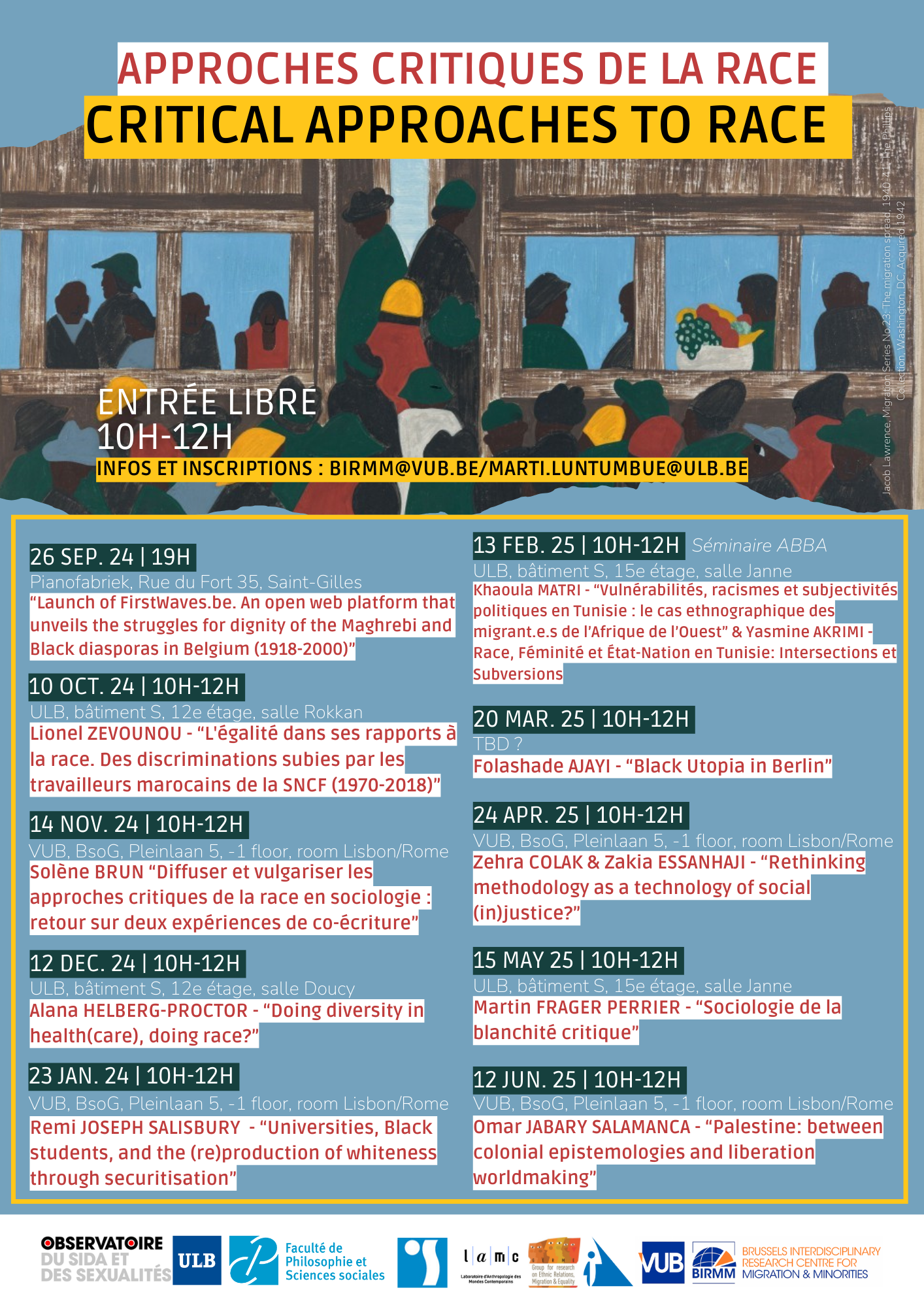
When: Thursdays, 10:00 AM to 12:00 PM
Where: Various venues, including ULB and VUB campuses
Entry: Free (registration encouraged)
Contact: birmm@vub.be / marti.luntumbue@ulb.be